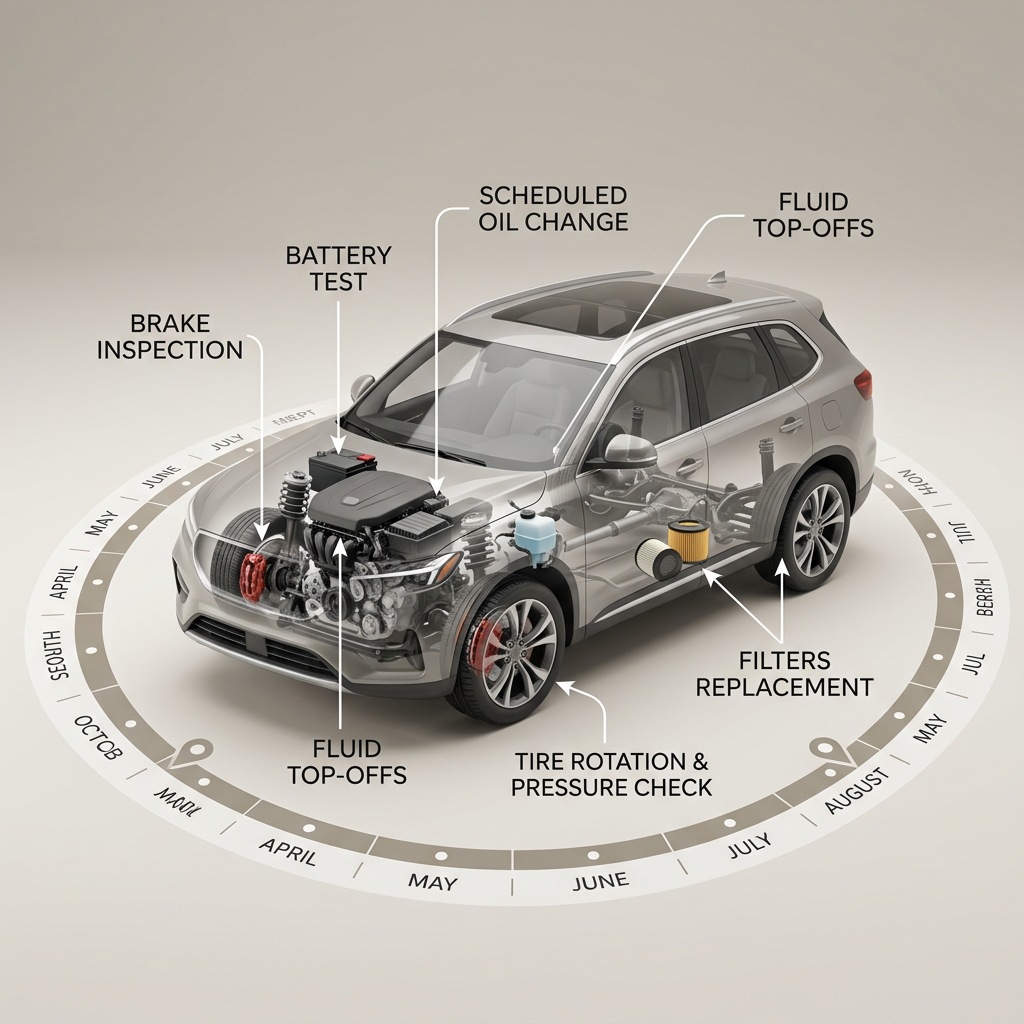

How Often Should You Get an Oil Change on a Ford Vehicle? If you drive a modern Ford vehicle—whether it's an efficient Ford Escape, a hardworking Ford F-150, or a versatile Ford Explorer—keeping up with routine oil changes is the single most effective action you can take to guarantee long-term engine performance, optimal fuel economy, and factory reliability. Under normal driving conditions, modern Ford cars, trucks, and SUVs using synthetic blend or full synthetic oil equipped with the Intelligent Oil-Life Monitor (IOLM) require service every 7,500 to 10,000 miles or once every 12 months, whichever occurs first. However, driving habits in Lancaster County and Ephrata often fall outside standard operational parameters. If you frequently tow trailers through rolling hills, navigate heavy stop-and-go commuter traffic along Route 222, idle during freezing Pennsylvania winters, or travel along dusty rural farm roads, your vehicle operates under what Ford classifies as severe driving conditions. In these scenarios, Ford recommends shortening your service window to every 3,000 to 5,000 miles or every 6 months to safeguard critical internal components against premature friction and thermal breakdown. For older Ford models (model year 2007 and earlier) that rely on conventional motor oil and traditional mechanical service schedules, standard service intervals remain fixed at 3,000 to 5,000 miles. At Twin Pine Ford, our team of factory-certified master technicians helps driver across Ephrata, Lititz, Reading, and Lancaster maintain peak engine protection through precise maintenance schedule tracking and factory-approved OEM Motorcraft lubricants. If you ever have questions about your specific model's oil life, you can Call us at 7177333673 to speak directly with our service advisory staff. How Does Ford's Intelligent Oil-Life Monitor (IOLM) Work? Gone are the days when drivers had to rely on static mileage stickers affixed to their windshields to guess when engine oil needed replacement. Standard on virtually all modern Ford vehicles, the Intelligent Oil-Life Monitor (IOLM) is an advanced algorithmic onboard diagnostic software system that calculates actual motor oil degradation in real time. Unlike traditional maintenance meters that simply count down odometer miles, the IOLM system continuously monitors severe engine operating variables. It analyzes engine operating temperatures, cumulative engine revolution counts, ambient weather conditions, idle duration, payload loads, and towing strain to evaluate how rapidly chemical breakdown and oxidation are occurring within your crankcase. When your oil life reaches 15%, your vehicle's information cluster displays a 'ENGINE OIL CHANGE SOON' notification. At 0%, the prompt shifts to 'OIL CHANGE REQUIRED', signaling that oil viscosity, anti-wear additive packages, and detergent reserves have reached minimum safe operating thresholds. Normal vs. Severe Driving Conditions in Lancaster County: What Alters Your Service Schedule? Understanding the precise operating environments of Lancaster County is essential for establishing an accurate service interval. Ford categorizes vehicle use into distinct operating brackets. Local driving habits in Ephrata, Lititz, and surrounding rural communities often push Ford engines into heavy-duty or severe operational categories. Normal Operating Conditions Interval: 7,500 – 10,000 miles / 1 Year • Cruising extended highway distances on open highways • Normal passenger payloads with minimal cargo • Flat to moderate road grades • Moderate ambient outdoor temperatures • Minimal extended engine idling Severe Operating Conditions Interval: 5,000 – 7,500 miles / 6 Months • Heavy stop-and-go commuting through local city centers • Frequent short trips under 10 miles in cold weather • Towing medium trailers or boat hauling • Driving in mountainous terrain or rolling PA hills • Sustained high-speed driving with full vehicle capacity Extreme Duty Conditions Interval: 3,000 – 5,000 miles / 3-6 Months • Heavy commercial towing near maximum GCVWR capacity • Excessive idling (construction sites or delivery routes) • Frequent travel across unpaved, dusty gravel farm roads • Severe winter conditions with prolonged low-speed operation What Type of Engine Oil Does Ford Recommend for Routine Service? Ford Motor Company engineers meticulously test and certify fluid formulations specifically tailored to their engine architectures. To preserve factory warranty coverage and maintain peak power delivery, Ford strongly recommends using Motorcraft Motor Oils meeting rigorous engineering material specifications such as WSS-M2C961-A1 or WSS-M2C962-A1. Depending on your engine type, recommended viscosity grades typically include: • 5W-20: Standard requirement for many naturally aspirated V6 and V8 Ford gasoline engines. • 5W-30: Recommended for high-output EcoBoost turbocharged engines requiring maximum high-temperature shear stability. • 0W-20: Specified for select hybrid powertrains and ultra-efficient late-model Ford engines for rapid oil pressure buildup during cold starts. Adhering strictly to factory-approved Motorcraft lubricants ensures your vehicle maintains correct oil pressure, prevents internal sludge buildup, and protects delicate turbocharger bearings from thermal breakdown. You can easily View Current Service Specials at Twin Pine Ford to find discounts on factory Motorcraft service packages. View Current Service Specials What Is the Difference Between Motorcraft Synthetic Blend and Full Synthetic Oil? When scheduling your Ford service at Twin Pine Ford, you have the choice between Motorcraft Synthetic Blend and Motorcraft Full Synthetic motor oil. Choosing the right lubricant depends on your vehicle's engine design, towing demands, and driving habits across Lancaster County. Feature / Characteristic Motorcraft Synthetic Blend Motorcraft Full Synthetic Base Formulation Premium synthetic stock combined with conventional mineral base oils 100% lab-engineered synthetic base stocks with ultra-pure molecules High-Temperature Resistance Excellent thermal stability for standard commuter driving Superior thermal break-down protection under extreme heat & turbo load Low-Temperature Flow Reliable cold-weather start flow down to freezing temperatures Instant pressure build-up during harsh sub-zero Pennsylvania winters Recommended For Standard commuter Fords (naturally aspirated gas engines) EcoBoost turbo engines, heavy towing F-150/Super Duty, performance Mustangs Typical Service Life Up to 7,500 miles under normal driving conditions Up to 10,000 miles maximum under normal driving conditions For high-performance EcoBoost turbocharged engines, full synthetic oil provides enhanced resistance against carbon deposit accumulation near high-temperature turbocharger shaft bearings. Owners who want maximum engine protection against wear often opt for Full Synthetic service. What Is Included in Ford's 'The Works' Oil Change Service Package? Ford's signature service package, known as 'The Works', goes far beyond a simple fluid swap. Designed by Ford engineers, it provides complete preventative care to catch minor mechanical issues before they turn into major repair bills. 1. Fluid & Filter Renewal • Up to 6 quarts of premium Motorcraft Synthetic Blend oil • Premium OEM Motorcraft oil filter with anti-drainback valve • Full fluid level inspection and top-off (windshield washer fluid, coolant reservoir, brake fluid) 2. Tire & Brake Service • Four-wheel tire rotation to promote even tread wear • Tire pressure inspection and adjustment (PSI calibration) • Detailed brake pad thickness measurement and rotor condition evaluation 3. Multi-Point Inspection • Comprehensive battery health test and terminal check • Visual inspection of belts, hoses, suspension, and steering components • Full Vehicle Health Report printout certified by our technicians How Driving an EcoBoost, PowerStroke Diesel, or Hybrid Ford Affects Oil Change Intervals Different Ford powertrain architectures place unique demands on engine lubricants. Whether you drive a turbocharged EcoBoost engine, a heavy-duty PowerStroke diesel truck, or a high-efficiency Ford hybrid, tailored maintenance is vital. 1. EcoBoost Turbocharged Gasoline Engines (1.5L, 2.0L, 2.7L, 3.5L V6): EcoBoost engines use turbochargers driven by exhaust gases reaching temperatures above 1,000°F. The engine oil lubricates turbine bearings operating at high RPMs. Motorcraft Full Synthetic oil prevents carbon coking on turbo shafts. While the IOLM permits up to 7,500–10,000 miles, twin-turbo EcoBoost drivers who frequently tow or commute in heavy traffic should consider changing oil every 5,000 to 7,500 miles. 2. PowerStroke Turbo Diesel Engines (6.7L V8 Diesel): Heavy-duty Ford Super Duty trucks equipped with the 6.7L PowerStroke Turbo Diesel require heavy-duty engine oils (such as Motorcraft 10W-30 or 5W-40 Diesel Motor Oil). Diesel combustion generates soot particles that accumulate in the crankcase. Oil change intervals typically range between 7,500 and 10,000 miles under normal highway driving, but drop to 5,000 miles or 250 engine hours when pulling heavy commercial trailers or idling extensively. 3. Ford Hybrid & Plug-in Hybrid Powertrains (Maverick Hybrid, Escape Hybrid): Ford hybrid powertrains cycle their internal combustion engine on and off continuously during short urban drives. Because hybrid gas engines frequently shut off before reaching full operating temperature, fuel and moisture vapor can condense inside the crankcase. Using ultra-low viscosity Motorcraft 0W-20 oil ensures immediate protection during engine restarts. Key Signs Your Ford Needs an Oil Change Before the Message Center Alerts You While Ford's Intelligent Oil-Life Monitor provides accurate tracking, physical symptoms can indicate premature oil breakdown or low oil levels. Inspecting your dipstick monthly is a smart practice. Dark, Gritty Oil Fresh Motorcraft oil is amber and translucent. If your dipstick reveals dark, opaque, or gritty oil, detergent additives are saturated and can no longer trap engine debris effectively. Engine Ticking / Knocking As oil breaks down, it loses lubricity. Metallic ticking or valvetrain chatter upon startup indicates oil viscosity has sheared down, delaying immediate lubrication to cylinder heads. Burning Smell / Vapor A hot oil odor inside the cabin or visible smoke from exhaust pipes suggests oil leakages or thermal breakdown. Bring your vehicle in immediately for professional evaluation. Book Your Service Appointment Why Routine Oil Changes Prevent Expensive Ford Engine Repairs Engine oil performs four vital roles: lubrication, cooling, cleaning, and sealing. Over thousands of miles, intense heat causes chemical oxidation, forming thick black sludge. Sludge restricts oil passages, starving critical components of lubrication. Deferred maintenance leads to severe mechanical issues: • Timing Chain Wear: Modern Ford engines rely on hydraulic timing chain tensioners powered by clean engine oil. Degraded or dirty oil causes premature chain stretch and costly timing system replacements. • Camshaft Phaser Failure: Variable Camshaft Timing (VCT) phasers rely on precise hydraulic oil pressure to adjust valve timing. Sludge clogs fine oil passages, causing engine knocking and check engine lights. • Turbocharger Bearing Damage: EcoBoost turbo shaft bearings spin at up to 200,000 RPM. Degraded oil bakes onto turbo bearings, resulting in turbo failure costing thousands to repair. Investing in timely oil changes at Twin Pine Ford avoids massive repair bills, preserves resale value, and maintains your warranty coverage under Learn About Ford Protect guidelines. Ford Oil Change Service Explained: Why Ephrata Drivers Trust Certified Techs While quick-lube shops offer basic oil drains, servicing your vehicle at Twin Pine Ford ensures factory-level care by Ford-trained technicians using genuine Motorcraft parts. Our technicians complete extensive factory training on every Ford powertrain. Key reasons Ephrata drivers trust Twin Pine Ford: • Factory-Trained Technicians: Expert mechanics specialized in Ford EcoBoost, PowerStroke diesel, and Hybrid engines. • OEM Motorcraft Filters: Engineered specifically for your engine, complete with silicone anti-drainback valves that prevent dry starts. • Specialized Diagnostic Tools: We perform factory software diagnostics, recalibrate your Intelligent Oil-Life Monitor, and log all service history into Ford's centralized warranty database. • Community Commitment: Serving Lancaster County for 70 years as a family-owned dealership offering a simple, transparent, and honest experience. Visit us at 620 N Reading Rd, Ephrata, PA 17522. Click to Get Directions to Twin Pine Ford or call our team today. How Can I Schedule a Ford Oil Change at Twin Pine Ford in Ephrata? Scheduling routine maintenance at Twin Pine Ford is simple and flexible. We respect your busy schedule and offer multiple convenient booking options: 1. Online Appointment Portal: Visit our website and select your preferred date, time, and service package via our online tool to Book Your Service Appointment in under two minutes. 2. Direct Phone Booking: Speak directly with an advisor by calling Call us at 7177333673. 3. FordPass™ Rewards Points: Earn points on vehicle purchases and maintenance visits, and redeem them toward future oil changes and service packages at Twin Pine Ford. 4. Pickup and Delivery Options: Ask about personalized service pickup and delivery options to save time. Schedule Your Ford Oil Change Service at Twin Pine Ford Today Don't delay essential engine maintenance. Protect your investment, maintain maximum fuel efficiency, and ensure lasting dependability across Lancaster County with factory-certified service from Twin Pine Ford in Ephrata, PA. Explore our service specials or schedule your appointment today! Book Your Service Appointment Ford Oil Change Intervals in Ephrata PA | Twin Pine Ford