What Documents Are Required to Trade In a Vehicle with an Active Auto Loan? Trading in a vehicle while you still owe money on an active auto loan is an everyday occurrence across Lancaster County, yet many car owners worry that having an open financing balance complicates or delays their purchase. The truth is quite the opposite: when you arrive prepared with the correct documentation, transferring an active auto loan to a dealership is a seamless, straightforward transaction. Dealership finance departments handle the entire payoff directly with your financial institution, coordinating the settlement and state title transfers behind the scenes. To ensure your transaction proceeds smoothly and without delays, you will need five core documents before sitting down with our finance specialists at Twin Pine Ford: • Official 10-Day Payoff Letter: An official document issued by your current lender indicating your precise loan balance, account number, and daily interest per diem calculated ten days into the future. • Current Vehicle Registration: A valid registration card proving legal ownership and confirming that the vehicle is actively registered in your name. • Valid State-Issued Driver's License: Government-issued photo identification verifying your identity against the lender's account records and titling paperwork. • Proof of Valid Auto Insurance: Current auto insurance policy documentation or an active digital insurance card displaying valid coverage dates. • All Sets of Keys and Remotes: Both primary and spare factory key fobs, valet keys, and any remote start fobs, which protect your vehicle's full appraisal value. Having these items ready eliminates back-and-forth telephone calls to customer service centers and allows our team to finalize your trade-in appraisal and structure your next vehicle purchase in a single visit. How to Obtain Your Official 10-Day Payoff Letter and Account Verification Many drivers assume that checking their current loan balance on a mobile banking application gives them all the information required to trade in their vehicle. However, the standard balance on your monthly billing statement only reflects the principal and interest accrued up to that specific billing cycle. Simple interest auto loans accrue interest on a per diem (daily) basis. This means the total amount required to settle the loan grows by a small calculation every single day until the funds are officially received and posted by the bank. A 10-day payoff statement is an official document generated by your lienholder projecting the exact payoff balance ten days into the future. This 10-day cushion ensures that during the time it takes the dealership to process the transaction, draft a corporate check or initiate an electronic funds transfer, and allow your lender to post the settlement, the payment clears the loan in its entirety without leaving an unpaid fractional balance. Obtaining this document takes only a few minutes before you leave home. You can secure it through either of these methods: • Online Banking Portal: Log into your financial institution's web portal or mobile app. Navigate to the loan details tab and locate the option titled "Request Payoff Quote" or "Generate Payoff Statement." Ensure you set the calculation date ten calendar days ahead and download the resulting PDF. • Customer Service Phone Line: Call your lender's automotive customer service line. Request a 10-day payoff quote and ask the representative to email or fax the statement directly to you or to the dealership. Our finance department requires four key pieces of lender data: the full lending institution name, the exact account number, the verified 10-day payoff dollar figure with per diem rates, and the lender's designated payoff mailing address or dealer payoff wire portal instructions. If you prefer, our team can contact your lender on your behalf while you evaluate Shop All New and Used Vehicles on our showroom floor. Driver's License, Vehicle Registration, and PA State Titling Requirements Pennsylvania has strict titling and vehicle transfer statutes enforced by the Pennsylvania Department of Transportation (PennDOT). When your vehicle has an active lien, the lender holds the physical certificate of title until the balance is satisfied. Because you do not possess the paper title, PennDOT requires specific documentation that allows a licensed automotive dealership to legally reassign the vehicle. First, all legal names on the vehicle registration and loan statement must match your valid, state-issued driver's license. If you have recently relocated or changed your name due to marriage or legal filing, bring supporting documentation such as your marriage certificate or certified name-change decree. Second, Pennsylvania utilizes a specialized secure document known as a Power of Attorney for Motor Vehicle Transactions (PennDOT Form MV-POA or dealership secure electronic equivalent). This document authorizes Twin Pine Ford to execute the physical title transfer once your bank releases the title following our payoff disbursement. If there is a co-signer or joint owner listed on the vehicle's title and registration, state regulations dictate that all registered parties must be present in person to sign the transfer forms and identification affidavits, or provide an original notarized Power of Attorney. How Long Does a Dealer Take to Send Payoff Funds to a Lender? Once your trade-in paperwork is completed and you drive home in your new vehicle, our accounting office initiates the payoff disbursement. In standard automotive accounting practices, dealerships process and dispatch loan payoffs within 5 to 10 business days. Depending on whether your lender participates in electronic dealer clearing networks or mandates physical payment, the funds are transmitted via expedited electronic clearinghouse wire or certified overnight courier with tracking. After your lender receives the payment, their internal lien release department takes between 3 to 15 business days to verify funds, update your account balance to zero, and electronically transmit the lien release to PennDOT or mail the satisfied certificate of title. What happens if an automatic loan payment is deducted during this window? If your recurring auto-debit draft occurs during the 10-day settlement period, there is no need to worry. The automatic payment merely reduces your total principal balance further. Once our dealership payoff check of the original quote amount is processed by your bank, an overpayment is created. Lenders are legally required to refund any surplus funds directly to you. Most banks automatically issue a refund check or direct deposit within 10 to 14 business days following final account closure. To begin reviewing your options before visiting our showroom, you can easily value your trade or review financing possibilities through our online tools. Get Your Instant Cash Offer Trading In with Positive Equity vs. Negative Equity: Paperwork and Financial Steps Your vehicle's equity position—the difference between its appraised market value and your outstanding loan balance—dictates how the financing structure and paperwork are assembled: • Positive Equity (Asset-Positive): When your vehicle is appraised at an amount higher than what you owe on your loan, you have positive equity. For example, if your trade-in appraisal is $22,000 and your 10-day payoff balance is $16,000, you have $6,000 in net positive equity. This $6,000 acts as an immediate cash-equivalent credit applied directly toward your new purchase, lowering your financed amount, reducing monthly payments, and decreasing your state tax burden. • Negative Equity (Underwater or Upside Down): When your payoff balance exceeds the vehicle's market value—such as owing $18,000 on a car appraised at $14,000—you have $4,000 in negative equity. You have two clear options: you may pay the $4,000 difference out of pocket via certified funds, debit, or personal check, or you can roll the remaining balance into your new vehicle's financing package, subject to lender loan-to-value guidelines. When rolling negative equity into a new auto loan, our finance team will submit an updated credit application to review your debt-to-income and loan-to-value parameters, ensuring you receive competitive interest terms and compliant financing disclosures. What Condition Ratings Do Dealerships Use During Vehicle Trade-In Appraisals? Professional automotive appraisers evaluate trade-in vehicles against four industry-standard condition tiers to determine an accurate, objective market valuation. Understanding where your vehicle fits helps set realistic expectations before your on-site appraisal. Excellent & Very Good Condition • Excellent (Top 3-5%): Looks showroom fresh. Absolutely zero mechanical flaws, matching tires with near-full tread, pristine paint without scratches or dings, clean Carfax with no accident history, and full scheduled service records. • Very Good: Minor, negligible cosmetic flaws such as small stone chips. Excellent mechanical health, clean interior upholstery, tires with ample life, passing all PA safety inspections without reconditioning work required. Good Condition (Industry Average) • Standard Daily Driver: Represents the majority of pre-owned vehicles. Free of major mechanical issues, but exhibits normal wear and tear appropriate for age and mileage. • Reconditioning Requirements: May require minor dent removal, shallow scratch buffing, interior detailing, brake pad replacement, or two new tires to pass stringent certified retail standards. • Clean Title: Valid title without frame damage or flood brands. Fair & Repairable Condition • Fair: The vehicle remains operational and road-legal but exhibits noticeable mechanical or cosmetic wear. May require immediate repairs to engine components, transmission servicing, or tire replacement. • Cosmetic & History: Noticeable body rust, dented panels, faded clear coat, worn cabin upholstery, or prior moderate accident records logged on vehicle history reports. • Wholesale Baseline: Often directed to regional wholesale dealer auctions. What Factors Determine a Vehicle's Trade-In Value at a Dealership? While physical and mechanical conditions establish the baseline grading, several broader economic and regional dynamics actively influence the final trade-in allowance offered by our appraisal specialists: • Regional Demand in Lancaster County: Vehicle utility changes dramatically based on geography. In Central Pennsylvania, capable all-wheel-drive crossovers, rugged four-wheel-drive trucks, and family-sized SUVs carry stronger secondary market values due to regional driving habits, rural road conditions, and winter weather resilience. • Seasonal Buying Patterns: Timing plays a pivotal role in wholesale pricing. During late autumn and winter, market appetites for trucks, commercial chassis, and AWD models accelerate, while convertibles and performance sports cars experience seasonal wholesale adjustments. • Real-Time Wholesale Auction Analytics: Dealerships track live transactional metrics from regional Manheim auctions and national Black Book analytics, cross-referencing actual realized sales rather than algorithmic consumer estimates. • Estimated Reconditioning Overhead: Every trade-in vehicle accepted onto our lot must undergo a rigorous multi-point inspection, fluid changes, brake evaluations, and safety checks before it can be offered to retail buyers. The parts, tires, and shop labor required to prepare the car directly factor into the appraisal figure. How Much Sales Tax Do You Save on a $15,000 Trade-In in PA? One of the most valuable financial advantages of trading in a vehicle at a licensed Pennsylvania dealership is the statutory Pennsylvania Trade-In Sales Tax Credit. Under Pennsylvania tax law, the agreed-upon gross trade-in allowance is deducted directly from the purchase price of your next vehicle before state sales tax is calculated. Pennsylvania's standard statewide motor vehicle sales tax rate is 6.0% (with Allegheny County at 7% and Philadelphia at 8%). When you trade in a vehicle with an agreed trade allowance of $15,000, you reduce your taxable purchase amount by that entire $15,000, creating an immediate tax savings of: $15,000 Trade-In Allowance × 6.0% PA Sales Tax = $900 Cash Tax Savings Take a look at how this mathematical advantage directly impacts your bottom line on a new purchase: Purchase Factor Without Trade-In With $15,000 Trade-In New Vehicle Purchase Price $40,000 $40,000 Trade-In Credit Allowance $0 -$15,000 Taxable Net Purchase Amount $40,000 $25,000 PA State Sales Tax (6.0%) $2,400 $1,500 Instant Out-of-Pocket Tax Savings $0 $900 Savings Crucially, this sales tax credit applies regardless of whether you have an active auto loan on the trade-in. Even if you owe $10,000 on that vehicle, your tax credit is calculated against the full $15,000 asset value, effectively offsetting negative equity or dramatically bolstering your positive equity position. Get Pre-Approved for Financing How Much More Money Do You Get Selling a Car Privately Versus Trading In? When evaluating whether to sell your car on your own or trade it into a dealership, drivers frequently note that private-party sales can generate roughly 10% to 15% higher gross listing prices. However, when an active bank loan is attached to the vehicle, selling privately becomes a complex, high-friction endeavor. Consider the major challenges of a private sale with an active lien: • Lien Settlement Obstacles: Private buyers rarely want to hand over thousands of dollars in cash or cashier's checks to a seller who cannot provide an immediate, clear title. In most cases, the buyer must accompany you to your bank branch or wire funds into escrow, waiting two to four weeks for your lender to process the satisfaction and mail the title. • Loss of the PA Sales Tax Credit: Selling privately forfeits the Pennsylvania sales tax offset entirely. On a $15,000 vehicle, you immediately lose $900 in tax savings, which instantly erodes the perceived profit margin of private selling. • Safety and Transaction Expenses: You must absorb the expense of online classified listings, arrange test drives with unfamiliar individuals, navigate fraudulent payment risks, and handle PennDOT notary fees yourself. When you factor in the $900+ tax savings and the complete elimination of lender payoff administration, trading in at Twin Pine Ford often results in equal or superior net financial value with zero personal hassle. Physical Items and Final Checklist to Bring Before Visiting Ephrata Before leaving your driveway in Ephrata, Reading, or Lancaster, run through this practical checklist of physical items to ensure you maximize your trade-in allowance and complete your exchange smoothly. Keys, Fobs & Remotes • Primary and Spare Smart Keys: Modern computer-programmed key fobs cost between $250 and $500 to replace. Bringing every original key fob prevents deductions from your appraisal. • Wheel Lock Keys: If your vehicle is equipped with anti-theft locking lug nuts, pack the dedicated wheel lock socket. • Accessory Remotes: Include remote start transmitters, aftermarket alarm fobs, and tonneau cover keys. Manuals & Service Records • Original Owner's Manual: Locate the complete glovebox booklet set, including audio/infotainment guides. • Documented Service History: Detailed receipts documenting routine oil services, brake changes, and transmission flushes validate that your car was maintained properly. • Warranty Documentation: Bring records of active transferable protection plans or recall completion slips. Vehicle Clearing & Data Reset • Infotainment Privacy Reset: Disconnect Bluetooth pairings, clear saved navigation home addresses, and log out of garage door openers (Homelink). • Cargo & Personal Goods: Check sunglasses compartments, under seats, seatback pockets, and trunk storage compartments. • Removable Media: Retain SD navigation cards or wireless smartphone chargers installed in the console. Why Drivers Around Lancaster Trade In Vehicle at Twin Pine Ford For over 70 years, Twin Pine Ford has stood as a family-owned community fixture serving drivers across Ephrata, Lititz, Denver PA, Lancaster PA, and Reading PA. Our approach to trade-ins is built upon a simple, transparent, and honest dealership experience supported by our renowned No-Haggle Price philosophy. When you trade in a vehicle with an active loan with us, you enjoy distinct advantages: • Direct Lender Relationships: Our finance team maintains direct automated connections with major financial institutions, Ford Credit, and regional credit unions, enabling rapid electronic balance verification and expedited payoff execution. • Objective, Transparent Appraisals: We walk you through every step of your trade appraisal, showing you real-time market data, auction records, and condition factors so you know you are receiving an honest, top-tier value. • Expansive New and Pre-Owned Selection: With 2 locations and 1 no-haggle price, we provide one of the widest selections of new Ford models and inspected pre-owned vehicles in the region. Whether you are moving up to an F-150, Explorer, or efficient SUV, finding the right fit is effortless. Discover the difference a transparent, family-owned dealership makes when parting with your current vehicle. Get Your Instant Trade-In Appraisal and Loan Payoff Assistance at Twin Pine Ford Ready to trade in your current vehicle and settle your existing loan without headaches? Our expert finance and appraisal team is here to handle every detail for you. You can obtain an upfront trade valuation online, allow our team to facilitate your bank payoff letters, or visit our dealership along Route 222 in person. Connect with our team today at Call 7177333673, plan your visit with Get Directions to Twin Pine Ford at 620 N Reading Rd, Ephrata, PA 17522, or take the next step below to speak with our trade-in specialists. Contact Our Team Today Auto Loan Trade-In in Ephrata, PA | Twin Pine Ford
Ford Winter Maintenance Plan
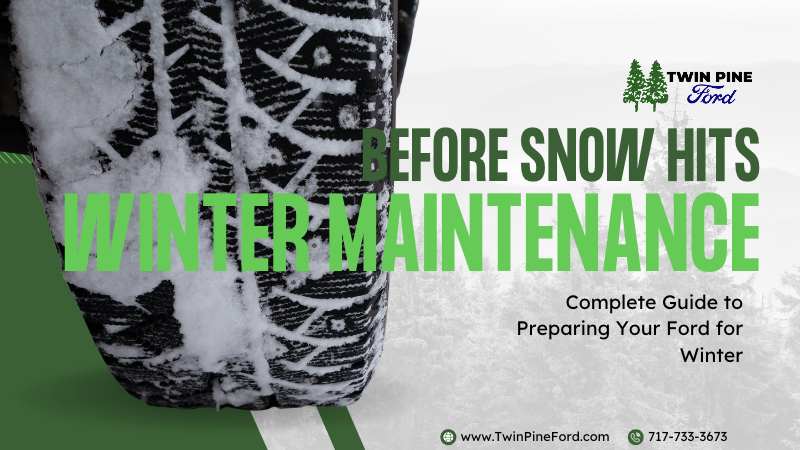
What Is the Recommended Minimum Tire Tread Depth for Driving on Winter Roads? When navigating the challenging freeze-and-thaw cycles of a Pennsylvania winter, having confidence in your vehicle starts where the rubber literally meets the frozen asphalt. The direct answer regarding winter road safety is clear: while the legal minimum tread depth across Pennsylvania is 2/32 of an inch, automotive safety engineers, tire manufacturers, and certified Ford technicians strongly recommend a minimum tread depth of 5/32 to 6/32 of an inch before tackling snow, slush, and frozen rural roadways. At 2/32 of an inch, your tires are legally worn out, and on wet or snow-covered surfaces, they lose almost all capability to channel winter slush away from the contact patch. To understand why 2/32 of an inch is inadequate in winter weather, consider the physics of winter traction. A tire does not grip hard-packed snow merely through surface friction against the rubber. Instead, it relies on snow-on-snow mechanical cohesion. Specialized winter and high-performance all-weather tread designs incorporate deep, lateral grooves and thousands of microscopic zig-zag slits called sipes. As your vehicle drives forward, these deep grooves pack loose snow into dense blocks inside the void areas. Snow grains bond aggressively with one another—providing far greater traction against the snowy road surface than frozen rubber ever could on its own. When your tread wears beneath 5/32 of an inch, these voids become too shallow to capture and compact snow. Simultaneously, the tire loses its ability to evacuate standing water and dense roadway slush. Without adequate groove volume, slush builds up ahead of the rolling contact patch, lifting the tire off the pavement. This leads directly to slushplaning or hydroplaning at speeds well below the posted limit on local corridors like Route 222 or Route 322. Maintaining 6/32 of an inch gives your Ford the void-to-tread ratio necessary to clear slush channels dynamically, keeping your tires firmly planted against solid ground. How to Accurately Measure Tread Depth at Home Using the Quarter and Penny Tests You do not need a professional service bay to run an initial check on your tire health before cold weather sets in. Two simple pocket coins—a Washington quarter and a Lincoln penny—give you immediate, practical benchmarks right in your Ephrata driveway. The Washington Quarter Test (Target: 4/32" to 5/32"): Take a quarter and turn George Washington upside down so his head faces downward into the tire tread. Insert the coin into several deep grooves across the tire. If the top of Washington's head is completely covered by the tread block, you have at least 4/32 of an inch of tread remaining. If his entire head and hair are visible, your tread is 4/32" or lower, meaning your tires lack the void depth required to evacuate slush and pack snow effectively. For reliable winter grip, you should plan on replacement right away. The Lincoln Penny Test (Bare Legal Minimum: 2/32"): Turn Abraham Lincoln upside down with his head facing the groove. If the top of Lincoln's head is visible, your tire tread has dropped to or below the legal minimum of 2/32 of an inch. At this stage, your tire is legally worn out across Pennsylvania, will fail state vehicle safety inspection, and creates an extreme safety hazard on wet or icy roads. Measuring Across Inner, Center, and Outer Ribs: Tires rarely wear down in a completely uniform pattern. Misalignment, worn suspension dampers, or incorrect tire pressure can cause the inner shoulder to wear down while the outer shoulder retains plenty of rubber. Always take measurements across three distinct points along the same tread plane: the inside shoulder, the center ribs, and the outside shoulder. Your actual tire condition is always dictated by the lowest measured groove. While coins offer quick estimates, our service team recommends using an inexpensive digital tire tread depth gauge. These digital gauges measure depth in thirty-seconds of an inch or millimeters with calibrated precision, eliminating any guesswork before winter blizzards arrive. If your tires measure between 4/32" and 5/32", they may get you through dry autumn commutes, but they will compromise steering control when descending slippery hills along the Cocalico Creek basin. Need an exact reading? Stop by our Ephrata service drive anytime for a complimentary digital tread analysis. Stopping Distances and Ice Traction: Why 2/32-Inch Legal Tread Fails on Slippery Roads The difference between stopping safely at a red light on Route 30 and sliding helplessly into an intersection comes down to your tread depth and siping density. Testing conducted by tire manufacturers and automotive safety organizations highlights a dramatic, non-linear correlation between tread depth loss and emergency braking distances in snow. Tread Depth Relative Snow Stopping Distance (30-0 MPH) Slush Evacuation Efficiency Safety Evaluation 10/32" (New) ~120 - 145 feet 100% (Maximum Channeling) Optimal Winter Performance 6/32" (Recommended Min) ~175 - 190 feet (+35%) 75% (Adequate Void Volume) Safe Winter Driving Threshold 4/32" (Marginal) ~230 - 260 feet (+70%) 45% (Noticeable Slushplaning) High Risk in Snow Accumulation 2/32" (Legal Minimum) ~360+ feet (+150%) 15% (Critical Hydroplaning Danger) Severe Hazard; Inadequate Traction The Physics of Sipes, Biting Edges, and Void Ratios: Modern winter and all-weather tires rely on complex tread engineering to maintain grip. Each individual tread block is scored with multiple high-density sipes—fine incisions that flex and deform under braking pressure. This flex generates thousands of razor-sharp biting edges that score the surface micro-texture of glazed snow and ice. When a tire wears down to 2/32 of an inch, those molded sipes disappear entirely because manufacturers stop sipe depth at 20% to 30% of total tread depth to preserve carcass structural rigidity. A worn tire transforms into an unbroken, hardened rubber band. When you depress the brake pedal on packed snow, anti-lock braking systems (ABS) pulse rapidly, but without biting edges to claw the surface or groove voids to compress snow grains, kinetic energy cannot be converted into stopping traction. On rural Lancaster County descents, stopping distances at 2/32" can increase by more than double the length of a football field compared to a fresh tire. What Is the Difference Between All-Weather Tires and All-Season Tires for Winter Driving? A common point of confusion among drivers is the difference between standard All-Season tires and newer All-Weather tires. While their names sound interchangeable, their chemical formulation and winter test certifications represent very different levels of capability when temperatures plummet across southeastern Pennsylvania. Standard All-Season (M+S) All-season tires carry the Mud and Snow (M+S) designation, which is based purely on geometric tread void ratios, not winter traction testing. Their rubber compounds utilize polymers engineered for tread life and fuel economy in warm weather. Once ambient temperatures dip below 45°F (7°C), the rubber stiffens and experiences 'glass transition,' losing pliability and failing to conform to cold pavement micro-textures. All-Weather (3PMSF Certified) All-weather tires bridge the gap. They feature the severe snow Three-Peak Mountain Snowflake (3PMSF) symbol, meaning they have passed rigorous ASTM winter traction testing on packed snow. Built with high-silica rubber compounds, all-weather tires stay supple well below freezing while remaining durable enough to run all summer long without swapping sets each spring. Dedicated Winter Tires Dedicated winter tires (such as Michelin X-Ice or Bridgestone Blizzak) use specialized hydrophilic compounds with microscopic pores that absorb thin water layers on ice. Featuring maximum sipe density, they provide unbeatable braking and cornering grip below 45°F. However, their soft compound wears rapidly in spring and summer heat, requiring seasonal swapping. Order Genuine Ford Parts Why Does Tire Pressure Drop When Temperatures Fall in Ephrata and Lancaster County? Every November across Lancaster County, drivers wake up on crisp mornings to see the low tire pressure warning light glowing on their instrument cluster. This seasonal drop in pressure is driven by fundamental physics—specifically Gay-Lussac's Law and the Ideal Gas Law (PV = nRT). When air cools inside a sealed tire chamber, the gas molecules lose kinetic energy, move slower, and collide less forcefully against the tire's inner walls. The reliable rule of thumb is that tire pressure drops by approximately 1 to 2 PSI for every 10-degree Fahrenheit drop in ambient temperature. When Ephrata experiences an autumn swing from a balmy 65°F afternoon down to a 25°F overnight freeze, your tires can easily lose 4 to 6 PSI without experiencing any physical leak, puncture, or valve stem flaw. The Dangers of Cold Under-Inflation: Driving on under-inflated tires during winter severely compromises vehicle dynamics. An under-inflated tire sags in the center of its contact patch, forcing vehicle weight onto the outer shoulders. This cupping effect closes up the central tread grooves, drastically reducing your tire's ability to evacuate slush and melted road snow. Under-inflation also increases rolling resistance, reduces fuel economy, and triggers uneven shoulder wear that shortens tire life. Furthermore, cold temperatures can cause valve stem rubber to harden slightly, increasing microscopic seepage. Check your tire pressures monthly using the cold-spec PSI values found on your Ford driver-door jamb sticker, rather than the maximum pressure molded onto the tire sidewall. Winter Road Readiness: Essential Cold-Weather Maintenance for Lancaster County Ford Drivers While maintaining proper tire tread depth is the cornerstone of winter driving safety, surviving a severe Pennsylvania freeze requires your entire vehicle to operate in harmony. From sub-zero battery cranking demand to clear visibility during freezing rain squalls, seasonal preventative care prevents inconvenient breakdowns along rural backroads. Battery Load Capacity At 32°F, a standard vehicle battery loses roughly 20% to 35% of its cranking power; at 0°F, available amperage plummets by nearly 60%. Meanwhile, thickened engine oil requires up to double the electrical power to turn over cold pistons. A professional battery conductance load test identifies failing cells before freezing temperatures leave you stranded. Explore our battery service insights to stay prepared. Synthetic Oil & Washer Fluids Conventional oils thicken rapidly in cold weather, delaying critical lubrication to upper valvetrains on cold start-ups. Upgrading to Motorcraft full synthetic or synthetic-blend 5W-20 or 5W-30 motor oil ensures instantaneous flow upon ignition. Simultaneously, switch out summer bug wash for winter-grade de-icing fluid rated to at least -20°F to prevent washer nozzles and pump lines from bursting. Silicone Wipers & Defrosting Standard rubber wiper blades freeze stiff, streak uncontrollably, and tear when clearing packed ice. Heavy-duty winter beam or silicone blades resist ice build-up inside the frame and retain full contact across curved windshield glass. Ensure your cabin HVAC blower motor and heated defrost grid operate seamlessly before the first morning frost arrives. What Cold-Weather Maintenance Does a Ford Vehicle Require Before Winter in Pennsylvania? Ford vehicles are engineered with sophisticated driveline technologies designed to master adverse weather, but these systems rely on proactive seasonal verification. Ford's Intelligent 4WD and AWD systems continually monitor wheel slippage, steering wheel angle, throttle position, and lateral acceleration hundreds of times per second. During pre-winter service, technicians verify electronic transfer case actuator function, rear differential clutch pack health, and Power Transfer Unit (PTU) fluid integrity. Coupled with AdvanceTrac with Roll Stability Control (RSC), your Ford selectively modulates individual brake calipers and adjusts engine output to counteract understeer or oversteer when crossing icy patches. However, AdvanceTrac's traction algorithms assume the vehicle is equipped with adequate tire tread depth. When tires are bald or mismatched in wear, the wheel-speed differential can confuse ABS sensors and degrade system response. Power Stroke Diesel Fuel Systems & Block Heaters: For Ford Super Duty drivers working farms across Denver and Lititz, cold weather demands diesel-specific preparation. At sub-freezing temperatures, paraffin wax molecules suspended in untreated diesel fuel crystallize, clogging primary and secondary fuel filters. Ensure your fuel filter water separator is drained of condensation, verify the internal fuel bowl heater heating element is operating, and test your 110V engine block heater cord for continuity. FordPass Diagnostic Monitoring: Modern Ford owners can leverage the FordPass mobile application to track live tire pressure monitoring (TPMS) data from their smartphone before stepping outside. FordPass also sends early warnings regarding 12V battery deep-sleep states and scheduled maintenance intervals, giving you full control over seasonal upkeep. Book Your Service Appointment How Often Should Engine Coolant Be Flushed and Tested for Freeze Protection? Engine coolant is not just for preventing overheating in summer traffic; its primary winter function is providing chemical freeze protection so that cooling jackets inside your engine block do not crack when parked during sustained cold snaps. Modern Ford vehicles generally utilize advanced Organic Acid Technology (OAT) coolant, such as Motorcraft Yellow Antifreeze/Coolant, which carries a manufacturer-recommended initial replacement interval of 6 years or 100,000 miles (subsequent flushes every 3 years or 50,000 miles). The 50/50 Dilution Ratio Standard: Coolant must be maintained at an exact 50/50 mixture of concentrated ethylene glycol and demineralized distilled water. This specific equilibrium provides freeze protection down to -34°F (-37°C) while simultaneously raising the boiling point to 265°F under pressure. If a driver mistakenly 'tops off' the coolant expansion tank with plain tap water over the summer, the mixture dilutes. Diluting coolant down to a 30/70 ratio raises the freezing threshold up to 10°F, leaving your engine block highly vulnerable during typical Lancaster County mid-winter drops. Hydrometer Testing and Acidic Degradation: Over years of thermal cycles, corrosion inhibitors such as carboxylates and silicates break down. When inhibitors deplete, coolant becomes acidic, attacking aluminum cylinder heads, copper heater cores, and radiator seals from within. Our factory-certified technicians test freeze protection levels and chemical pH using optical refractometers and digital hydrometers to ensure your cooling system retains factory-grade defense. Never mix incompatible coolant colors, such as older green or orange formulations with Motorcraft Yellow. Incompatible chemistries can coagulate into a thick gel that blocks narrow heater core passageways, robbing your cabin of heat on the coldest mornings. How Does Road Salt and Brine Used on Pennsylvania Highways Affect Ford Undercarriages, and How Can It Be Prevented? PennDOT maintenance crews work tirelessly to keep major arterial roads like Route 222, Route 30, and the PA Turnpike passable during winter storms. However, the chemicals used—predominantly liquid rock salt brine and liquid magnesium chloride (MgCl2)—pose severe corrosive threats to vehicle underbodies. Unlike traditional crystalline rock salt that bounces off pavements, liquid brine is an engineered liquid anti-icer. When sprayed before a storm, it coats roadways evenly. As traffic drives over the treated pavement, rolling tires atomize this brine into a fine chemical mist that penetrates deep into chassis seams, rocker panels, subframes, steering knuckles, and electrical wiring connectors. Magnesium chloride is particularly aggressive because it is hygroscopic; it draws moisture out of the surrounding air even when dry, maintaining active electrolytic corrosion across exposed metals well after the storm has ended. Prevention and Protection Best Practices: While modern Ford trucks and SUVs utilize high-strength, military-grade aluminum alloy bodies that naturally resist red rust, steel chassis components, suspension links, brake lines, and fasteners require ongoing seasonal protection: • Routine Undercarriage Flushes: Rinse your vehicle's underbody at least once every 10 to 14 days during active salting periods. Avoid high-pressure blasts into delicate electrical sensors, but thoroughly wash out boxed frame rails and wheel wells. • Corrosion Inhibiting Barriers: Before winter, apply a petroleum- or lanolin-based underbody penetrant coating to critical suspension parts, brake line brackets, and trailer hitch receivers. • Brake Line and Caliper Slide Inspections: Salt crystallization causes brake caliper slider pins to seize and speeds up surface pitting on brake rotors. Routine inspections maintain consistent pedal feel when stopping on slippery surfaces. Review our brake service guide to ensure your stopping hardware is fully protected. Navigating Rural Lancaster County Rolling Hills and Farmland Snowdrifts Driving through Lancaster County in the dead of winter is uniquely beautiful, but our pastoral geography creates localized driving challenges not found on interstate highways. Open agricultural fields across Ephrata, Clay, Upper Leacock, and Warwick Townships lack natural windbreaks or highway tree barriers. High winter winds sweep uninterrupted across open cornfields, picking up loose snow and depositing sudden, dense snowdrifts across two-lane rural roads like Route 772, Rothsville Road, and Schoeneck Road. A pavement surface that appears bone-dry on a straightaway can abruptly transition into an eight-inch snowdrift or a sheet of invisible black ice as you round an elevation change. Rolling hills along the Susquehanna River Valley and Welsh Mountain create dramatic micro-climates. Valley bottoms near creek beds often sit 5 to 8 degrees colder than higher plateaus, causing condensation from morning fog to freeze instantly onto asphalt bridges and shaded hollows. When climbing or descending these steep, rolling rural grades, adequate tire tread depth is what prevents your vehicle from losing directional control. Adequate tread depth allows your tires to cut down through the powdery surface drift to bite into underlying asphalt. If your tread is worn down toward the legal minimum, tires simply ride up on top of the drift like skis, breaking traction and triggering vehicle yaw that even advanced stability systems cannot overcome. What Should Be Included in an Emergency Winter Car Kit for Lancaster County Rural Backroads? On remote backroads where mobile cell reception can drop out in valleys and tow truck response times lengthen during heavy blizzards, keeping a dedicated cold-weather emergency kit in your Ford trunk or truck bed is essential peace of mind. Prepare these three categories of survival equipment before winter storms hit: Traction & Recovery Gear • Compact Folding Shovel: Heavy-duty aluminum or tactical polymer scoop to clear packed snow from under-chassis hang-ups. • Traction Substrate: A 20-lb bag of non-clumping clay cat litter or coarse sand to pour directly under spinning drive tires. • Tow Recovery Strap: Heavy-duty 20,000-lb rated strap with looped ends for vehicle-to-vehicle recovery. Jump Starting & Lighting • Lithium Jump-Starter Pack: High-output portable pack that starts dead batteries without relying on a second vehicle. • Heavy-Duty Jumper Cables: 4-gauge, 20-foot copper cables for cold-cranking reliability. • LED Headlamp & Flare Beacons: Hands-free illumination and magnetic roadside emergency flashing beacons for night visibility. Personal Warmth & Sustenance • Thermal Blankets: Reflective Mylar space blankets plus wool blankets to retain body heat if the engine cannot run. • Cold-Weather Apparel: Insulated gloves, wool socks, waterproof knit cap, and hand warmers. • Non-Perishable Food: High-protein energy bars, dried fruits, and metal water bottles that won't burst when frozen. Request Mobile Service When to Replace Tires vs. Rotate: Identifying Uneven Winter Wear Patterns Before deciding whether to replace or simply rotate your tires ahead of winter, a close physical inspection of the tread face will reveal critical diagnostic details regarding your vehicle's mechanical alignment and inflation history: • Center Rib Wear: When the center of the tire tread is worn deeper than the shoulders, the tire has been run over-inflated. This reduces your footprint and limits the contact area needed for icy traction. • Shoulder Wear (Both Edges): Both outer edges worn smooth while the center has depth indicates sustained under-inflation, which creates premature heat buildup and slushplaning risks. • Feathering across the Tread: When tread blocks feel smooth when sliding your hand one way across the tire, but sharp and jagged when sliding the other, your vehicle's toe alignment is out of spec. • Cupping or Scalloping: Rhythmic high-and-low dips around the circumference suggest worn suspension dampers, bad wheel bearings, or out-of-balance assemblies, causing the tire to bounce down the road. The 5,000 to 7,500-Mile Rotation Rule: Rotating your tires every 5,000 to 7,500 miles—coinciding with your oil change interval—ensures uniform tread wear across front steering and rear load-bearing axles. If your front tires have worn down to 5/32" while the rears retain 8/32", rotating the deeper tread to the rear axle is critical for vehicle stability, preventing dangerous oversteer slides on snowy turns. Schedule Your Ford Winter Tire and Seasonal Inspection at Twin Pine Ford in Ephrata Don't wait for the first major Pennsylvania snowstorm to discover that your tire tread has dropped into the danger zone. At Twin Pine Ford in Ephrata, our factory-trained and certified technicians have proudly served our local community for over 70 years with a transparent, honest, and customer-first approach. Whether you need a precision digital tread depth evaluation, a winter multi-point inspection, battery conductance testing, or a new set of severe-snow rated tires backed by nationwide warranty protection, we have you covered. Enjoy our simple, transparent experience, competitive tire price match guarantees, and the convenience of our complimentary pickup and delivery options. Visit us today at 620 N Reading Rd in Ephrata, PA, or give our friendly service advisors a call directly at 717-733-3673 to ensure your Ford is ready for every mile of winter weather ahead. What Is the Recommended Minimum Tire Tread Depth for Driving on Winter Roads? When navigating the challenging freeze-and-thaw cycles of a Pennsylvania winter, having confidence in your vehicle starts where the rubber literally meets the frozen asphalt. The direct answer regarding winter road safety is clear: while the legal minimum tread depth across Pennsylvania is 2/32 of an inch, automotive safety engineers, tire manufacturers, and certified Ford technicians strongly recommend a minimum tread depth of 5/32 to 6/32 of an inch before tackling snow, slush, and frozen rural roadways. At 2/32 of an inch, your tires are legally worn out, and on wet or snow-covered surfaces, they lose almost all capability to channel winter slush away from the contact patch. To understand why 2/32 of an inch is inadequate in winter weather, consider the physics of winter traction. A tire does not grip hard-packed snow merely through surface friction against the rubber. Instead, it relies on snow-on-snow mechanical cohesion. Specialized winter and high-performance all-weather tread designs incorporate deep, lateral grooves and thousands of microscopic zig-zag slits called sipes. As your vehicle drives forward, these deep grooves pack loose snow into dense blocks inside the void areas. Snow grains bond aggressively with one another—providing far greater traction against the snowy road surface than frozen rubber ever could on its own. When your tread wears beneath 5/32 of an inch, these voids become too shallow to capture and compact snow. Simultaneously, the tire loses its ability to evacuate standing water and dense roadway slush. Without adequate groove volume, slush builds up ahead of the rolling contact patch, lifting the tire off the pavement. This leads directly to slushplaning or hydroplaning at speeds well below the posted limit on local corridors like Route 222 or Route 322. Maintaining 6/32 of an inch gives your Ford the void-to-tread ratio necessary to clear slush channels dynamically, keeping your tires firmly planted against solid ground. How to Accurately Measure Tread Depth at Home Using the Quarter and Penny Tests You do not need a professional service bay to run an initial check on your tire health before cold weather sets in. Two simple pocket coins—a Washington quarter and a Lincoln penny—give you immediate, practical benchmarks right in your Ephrata driveway. The Washington Quarter Test (Target: 4/32" to 5/32"): Take a quarter and turn George Washington upside down so his head faces downward into the tire tread. Insert the coin into several deep grooves across the tire. If the top of Washington's head is completely covered by the tread block, you have at least 4/32 of an inch of tread remaining. If his entire head and hair are visible, your tread is 4/32" or lower, meaning your tires lack the void depth required to evacuate slush and pack snow effectively. For reliable winter grip, you should plan on replacement right away. The Lincoln Penny Test (Bare Legal Minimum: 2/32"): Turn Abraham Lincoln upside down with his head facing the groove. If the top of Lincoln's head is visible, your tire tread has dropped to or below the legal minimum of 2/32 of an inch. At this stage, your tire is legally worn out across Pennsylvania, will fail state vehicle safety inspection, and creates an extreme safety hazard on wet or icy roads. Measuring Across Inner, Center, and Outer Ribs: Tires rarely wear down in a completely uniform pattern. Misalignment, worn suspension dampers, or incorrect tire pressure can cause the inner shoulder to wear down while the outer shoulder retains plenty of rubber. Always take measurements across three distinct points along the same tread plane: the inside shoulder, the center ribs, and the outside shoulder. Your actual tire condition is always dictated by the lowest measured groove. While coins offer quick estimates, our service team recommends using an inexpensive digital tire tread depth gauge. These digital gauges measure depth in thirty-seconds of an inch or millimeters with calibrated precision, eliminating any guesswork before winter blizzards arrive. If your tires measure between 4/32" and 5/32", they may get you through dry autumn commutes, but they will compromise steering control when descending slippery hills along the Cocalico Creek basin. Need an exact reading? Stop by our Ephrata service drive anytime for a complimentary digital tread analysis. Stopping Distances and Ice Traction: Why 2/32-Inch Legal Tread Fails on Slippery Roads The difference between stopping safely at a red light on Route 30 and sliding helplessly into an intersection comes down to your tread depth and siping density. Testing conducted by tire manufacturers and automotive safety organizations highlights a dramatic, non-linear correlation between tread depth loss and emergency braking distances in snow. Tread Depth Relative Snow Stopping Distance (30-0 MPH) Slush Evacuation Efficiency Safety Evaluation 10/32" (New) ~120 - 145 feet 100% (Maximum Channeling) Optimal Winter Performance 6/32" (Recommended Min) ~175 - 190 feet (+35%) 75% (Adequate Void Volume) Safe Winter Driving Threshold 4/32" (Marginal) ~230 - 260 feet (+70%) 45% (Noticeable Slushplaning) High Risk in Snow Accumulation 2/32" (Legal Minimum) ~360+ feet (+150%) 15% (Critical Hydroplaning Danger) Severe Hazard; Inadequate Traction The Physics of Sipes, Biting Edges, and Void Ratios: Modern winter and all-weather tires rely on complex tread engineering to maintain grip. Each individual tread block is scored with multiple high-density sipes—fine incisions that flex and deform under braking pressure. This flex generates thousands of razor-sharp biting edges that score the surface micro-texture of glazed snow and ice. When a tire wears down to 2/32 of an inch, those molded sipes disappear entirely because manufacturers stop sipe depth at 20% to 30% of total tread depth to preserve carcass structural rigidity. A worn tire transforms into an unbroken, hardened rubber band. When you depress the brake pedal on packed snow, anti-lock braking systems (ABS) pulse rapidly, but without biting edges to claw the surface or groove voids to compress snow grains, kinetic energy cannot be converted into stopping traction. On rural Lancaster County descents, stopping distances at 2/32" can increase by more than double the length of a football field compared to a fresh tire. What Is the Difference Between All-Weather Tires and All-Season Tires for Winter Driving? A common point of confusion among drivers is the difference between standard All-Season tires and newer All-Weather tires. While their names sound interchangeable, their chemical formulation and winter test certifications represent very different levels of capability when temperatures plummet across southeastern Pennsylvania. Standard All-Season (M+S) All-season tires carry the Mud and Snow (M+S) designation, which is based purely on geometric tread void ratios, not winter traction testing. Their rubber compounds utilize polymers engineered for tread life and fuel economy in warm weather. Once ambient temperatures dip below 45°F (7°C), the rubber stiffens and experiences 'glass transition,' losing pliability and failing to conform to cold pavement micro-textures. All-Weather (3PMSF Certified) All-weather tires bridge the gap. They feature the severe snow Three-Peak Mountain Snowflake (3PMSF) symbol, meaning they have passed rigorous ASTM winter traction testing on packed snow. Built with high-silica rubber compounds, all-weather tires stay supple well below freezing while remaining durable enough to run all summer long without swapping sets each spring. Dedicated Winter Tires Dedicated winter tires (such as Michelin X-Ice or Bridgestone Blizzak) use specialized hydrophilic compounds with microscopic pores that absorb thin water layers on ice. Featuring maximum sipe density, they provide unbeatable braking and cornering grip below 45°F. However, their soft compound wears rapidly in spring and summer heat, requiring seasonal swapping. Order Genuine Ford Parts Why Does Tire Pressure Drop When Temperatures Fall in Ephrata and Lancaster County? Every November across Lancaster County, drivers wake up on crisp mornings to see the low tire pressure warning light glowing on their instrument cluster. This seasonal drop in pressure is driven by fundamental physics—specifically Gay-Lussac's Law and the Ideal Gas Law (PV = nRT). When air cools inside a sealed tire chamber, the gas molecules lose kinetic energy, move slower, and collide less forcefully against the tire's inner walls. The reliable rule of thumb is that tire pressure drops by approximately 1 to 2 PSI for every 10-degree Fahrenheit drop in ambient temperature. When Ephrata experiences an autumn swing from a balmy 65°F afternoon down to a 25°F overnight freeze, your tires can easily lose 4 to 6 PSI without experiencing any physical leak, puncture, or valve stem flaw. The Dangers of Cold Under-Inflation: Driving on under-inflated tires during winter severely compromises vehicle dynamics. An under-inflated tire sags in the center of its contact patch, forcing vehicle weight onto the outer shoulders. This cupping effect closes up the central tread grooves, drastically reducing your tire's ability to evacuate slush and melted road snow. Under-inflation also increases rolling resistance, reduces fuel economy, and triggers uneven shoulder wear that shortens tire life. Furthermore, cold temperatures can cause valve stem rubber to harden slightly, increasing microscopic seepage. Check your tire pressures monthly using the cold-spec PSI values found on your Ford driver-door jamb sticker, rather than the maximum pressure molded onto the tire sidewall. Winter Road Readiness: Essential Cold-Weather Maintenance for Lancaster County Ford Drivers While maintaining proper tire tread depth is the cornerstone of winter driving safety, surviving a severe Pennsylvania freeze requires your entire vehicle to operate in harmony. From sub-zero battery cranking demand to clear visibility during freezing rain squalls, seasonal preventative care prevents inconvenient breakdowns along rural backroads. Battery Load Capacity At 32°F, a standard vehicle battery loses roughly 20% to 35% of its cranking power; at 0°F, available amperage plummets by nearly 60%. Meanwhile, thickened engine oil requires up to double the electrical power to turn over cold pistons. A professional battery conductance load test identifies failing cells before freezing temperatures leave you stranded. Explore our battery service insights to stay prepared. Synthetic Oil & Washer Fluids Conventional oils thicken rapidly in cold weather, delaying critical lubrication to upper valvetrains on cold start-ups. Upgrading to Motorcraft full synthetic or synthetic-blend 5W-20 or 5W-30 motor oil ensures instantaneous flow upon ignition. Simultaneously, switch out summer bug wash for winter-grade de-icing fluid rated to at least -20°F to prevent washer nozzles and pump lines from bursting. Silicone Wipers & Defrosting Standard rubber wiper blades freeze stiff, streak uncontrollably, and tear when clearing packed ice. Heavy-duty winter beam or silicone blades resist ice build-up inside the frame and retain full contact across curved windshield glass. Ensure your cabin HVAC blower motor and heated defrost grid operate seamlessly before the first morning frost arrives. What Cold-Weather Maintenance Does a Ford Vehicle Require Before Winter in Pennsylvania? Ford vehicles are engineered with sophisticated driveline technologies designed to master adverse weather, but these systems rely on proactive seasonal verification. Ford's Intelligent 4WD and AWD systems continually monitor wheel slippage, steering wheel angle, throttle position, and lateral acceleration hundreds of times per second. During pre-winter service, technicians verify electronic transfer case actuator function, rear differential clutch pack health, and Power Transfer Unit (PTU) fluid integrity. Coupled with AdvanceTrac with Roll Stability Control (RSC), your Ford selectively modulates individual brake calipers and adjusts engine output to counteract understeer or oversteer when crossing icy patches. However, AdvanceTrac's traction algorithms assume the vehicle is equipped with adequate tire tread depth. When tires are bald or mismatched in wear, the wheel-speed differential can confuse ABS sensors and degrade system response. Power Stroke Diesel Fuel Systems & Block Heaters: For Ford Super Duty drivers working farms across Denver and Lititz, cold weather demands diesel-specific preparation. At sub-freezing temperatures, paraffin wax molecules suspended in untreated diesel fuel crystallize, clogging primary and secondary fuel filters. Ensure your fuel filter water separator is drained of condensation, verify the internal fuel bowl heater heating element is operating, and test your 110V engine block heater cord for continuity. FordPass Diagnostic Monitoring: Modern Ford owners can leverage the FordPass mobile application to track live tire pressure monitoring (TPMS) data from their smartphone before stepping outside. FordPass also sends early warnings regarding 12V battery deep-sleep states and scheduled maintenance intervals, giving you full control over seasonal upkeep. Book Your Service Appointment How Often Should Engine Coolant Be Flushed and Tested for Freeze Protection? Engine coolant is not just for preventing overheating in summer traffic; its primary winter function is providing chemical freeze protection so that cooling jackets inside your engine block do not crack when parked during sustained cold snaps. Modern Ford vehicles generally utilize advanced Organic Acid Technology (OAT) coolant, such as Motorcraft Yellow Antifreeze/Coolant, which carries a manufacturer-recommended initial replacement interval of 6 years or 100,000 miles (subsequent flushes every 3 years or 50,000 miles). The 50/50 Dilution Ratio Standard: Coolant must be maintained at an exact 50/50 mixture of concentrated ethylene glycol and demineralized distilled water. This specific equilibrium provides freeze protection down to -34°F (-37°C) while simultaneously raising the boiling point to 265°F under pressure. If a driver mistakenly 'tops off' the coolant expansion tank with plain tap water over the summer, the mixture dilutes. Diluting coolant down to a 30/70 ratio raises the freezing threshold up to 10°F, leaving your engine block highly vulnerable during typical Lancaster County mid-winter drops. Hydrometer Testing and Acidic Degradation: Over years of thermal cycles, corrosion inhibitors such as carboxylates and silicates break down. When inhibitors deplete, coolant becomes acidic, attacking aluminum cylinder heads, copper heater cores, and radiator seals from within. Our factory-certified technicians test freeze protection levels and chemical pH using optical refractometers and digital hydrometers to ensure your cooling system retains factory-grade defense. Never mix incompatible coolant colors, such as older green or orange formulations with Motorcraft Yellow. Incompatible chemistries can coagulate into a thick gel that blocks narrow heater core passageways, robbing your cabin of heat on the coldest mornings. How Does Road Salt and Brine Used on Pennsylvania Highways Affect Ford Undercarriages, and How Can It Be Prevented? PennDOT maintenance crews work tirelessly to keep major arterial roads like Route 222, Route 30, and the PA Turnpike passable during winter storms. However, the chemicals used—predominantly liquid rock salt brine and liquid magnesium chloride (MgCl2)—pose severe corrosive threats to vehicle underbodies. Unlike traditional crystalline rock salt that bounces off pavements, liquid brine is an engineered liquid anti-icer. When sprayed before a storm, it coats roadways evenly. As traffic drives over the treated pavement, rolling tires atomize this brine into a fine chemical mist that penetrates deep into chassis seams, rocker panels, subframes, steering knuckles, and electrical wiring connectors. Magnesium chloride is particularly aggressive because it is hygroscopic; it draws moisture out of the surrounding air even when dry, maintaining active electrolytic corrosion across exposed metals well after the storm has ended. Prevention and Protection Best Practices: While modern Ford trucks and SUVs utilize high-strength, military-grade aluminum alloy bodies that naturally resist red rust, steel chassis components, suspension links, brake lines, and fasteners require ongoing seasonal protection: • Routine Undercarriage Flushes: Rinse your vehicle's underbody at least once every 10 to 14 days during active salting periods. Avoid high-pressure blasts into delicate electrical sensors, but thoroughly wash out boxed frame rails and wheel wells. • Corrosion Inhibiting Barriers: Before winter, apply a petroleum- or lanolin-based underbody penetrant coating to critical suspension parts, brake line brackets, and trailer hitch receivers. • Brake Line and Caliper Slide Inspections: Salt crystallization causes brake caliper slider pins to seize and speeds up surface pitting on brake rotors. Routine inspections maintain consistent pedal feel when stopping on slippery surfaces. Review our brake service guide to ensure your stopping hardware is fully protected. Navigating Rural Lancaster County Rolling Hills and Farmland Snowdrifts Driving through Lancaster County in the dead of winter is uniquely beautiful, but our pastoral geography creates localized driving challenges not found on interstate highways. Open agricultural fields across Ephrata, Clay, Upper Leacock, and Warwick Townships lack natural windbreaks or highway tree barriers. High winter winds sweep uninterrupted across open cornfields, picking up loose snow and depositing sudden, dense snowdrifts across two-lane rural roads like Route 772, Rothsville Road, and Schoeneck Road. A pavement surface that appears bone-dry on a straightaway can abruptly transition into an eight-inch snowdrift or a sheet of invisible black ice as you round an elevation change. Rolling hills along the Susquehanna River Valley and Welsh Mountain create dramatic micro-climates. Valley bottoms near creek beds often sit 5 to 8 degrees colder than higher plateaus, causing condensation from morning fog to freeze instantly onto asphalt bridges and shaded hollows. When climbing or descending these steep, rolling rural grades, adequate tire tread depth is what prevents your vehicle from losing directional control. Adequate tread depth allows your tires to cut down through the powdery surface drift to bite into underlying asphalt. If your tread is worn down toward the legal minimum, tires simply ride up on top of the drift like skis, breaking traction and triggering vehicle yaw that even advanced stability systems cannot overcome. What Should Be Included in an Emergency Winter Car Kit for Lancaster County Rural Backroads? On remote backroads where mobile cell reception can drop out in valleys and tow truck response times lengthen during heavy blizzards, keeping a dedicated cold-weather emergency kit in your Ford trunk or truck bed is essential peace of mind. Prepare these three categories of survival equipment before winter storms hit: Traction & Recovery Gear • Compact Folding Shovel: Heavy-duty aluminum or tactical polymer scoop to clear packed snow from under-chassis hang-ups. • Traction Substrate: A 20-lb bag of non-clumping clay cat litter or coarse sand to pour directly under spinning drive tires. • Tow Recovery Strap: Heavy-duty 20,000-lb rated strap with looped ends for vehicle-to-vehicle recovery. Jump Starting & Lighting • Lithium Jump-Starter Pack: High-output portable pack that starts dead batteries without relying on a second vehicle. • Heavy-Duty Jumper Cables: 4-gauge, 20-foot copper cables for cold-cranking reliability. • LED Headlamp & Flare Beacons: Hands-free illumination and magnetic roadside emergency flashing beacons for night visibility. Personal Warmth & Sustenance • Thermal Blankets: Reflective Mylar space blankets plus wool blankets to retain body heat if the engine cannot run. • Cold-Weather Apparel: Insulated gloves, wool socks, waterproof knit cap, and hand warmers. • Non-Perishable Food: High-protein energy bars, dried fruits, and metal water bottles that won't burst when frozen. Request Mobile Service When to Replace Tires vs. Rotate: Identifying Uneven Winter Wear Patterns Before deciding whether to replace or simply rotate your tires ahead of winter, a close physical inspection of the tread face will reveal critical diagnostic details regarding your vehicle's mechanical alignment and inflation history: • Center Rib Wear: When the center of the tire tread is worn deeper than the shoulders, the tire has been run over-inflated. This reduces your footprint and limits the contact area needed for icy traction. • Shoulder Wear (Both Edges): Both outer edges worn smooth while the center has depth indicates sustained under-inflation, which creates premature heat buildup and slushplaning risks. • Feathering across the Tread: When tread blocks feel smooth when sliding your hand one way across the tire, but sharp and jagged when sliding the other, your vehicle's toe alignment is out of spec. • Cupping or Scalloping: Rhythmic high-and-low dips around the circumference suggest worn suspension dampers, bad wheel bearings, or out-of-balance assemblies, causing the tire to bounce down the road. The 5,000 to 7,500-Mile Rotation Rule: Rotating your tires every 5,000 to 7,500 miles—coinciding with your oil change interval—ensures uniform tread wear across front steering and rear load-bearing axles. If your front tires have worn down to 5/32" while the rears retain 8/32", rotating the deeper tread to the rear axle is critical for vehicle stability, preventing dangerous oversteer slides on snowy turns. Schedule Your Ford Winter Tire and Seasonal Inspection at Twin Pine Ford in Ephrata Don't wait for the first major Pennsylvania snowstorm to discover that your tire tread has dropped into the danger zone. At Twin Pine Ford in Ephrata, our factory-trained and certified technicians have proudly served our local community for over 70 years with a transparent, honest, and customer-first approach. Whether you need a precision digital tread depth evaluation, a winter multi-point inspection, battery conductance testing, or a new set of severe-snow rated tires backed by nationwide warranty protection, we have you covered. Enjoy our simple, transparent experience, competitive tire price match guarantees, and the convenience of our complimentary pickup and delivery options. Visit us today at 620 N Reading Rd in Ephrata, PA, or give our friendly service advisors a call directly at 717-733-3673 to ensure your Ford is ready for every mile of winter weather ahead.